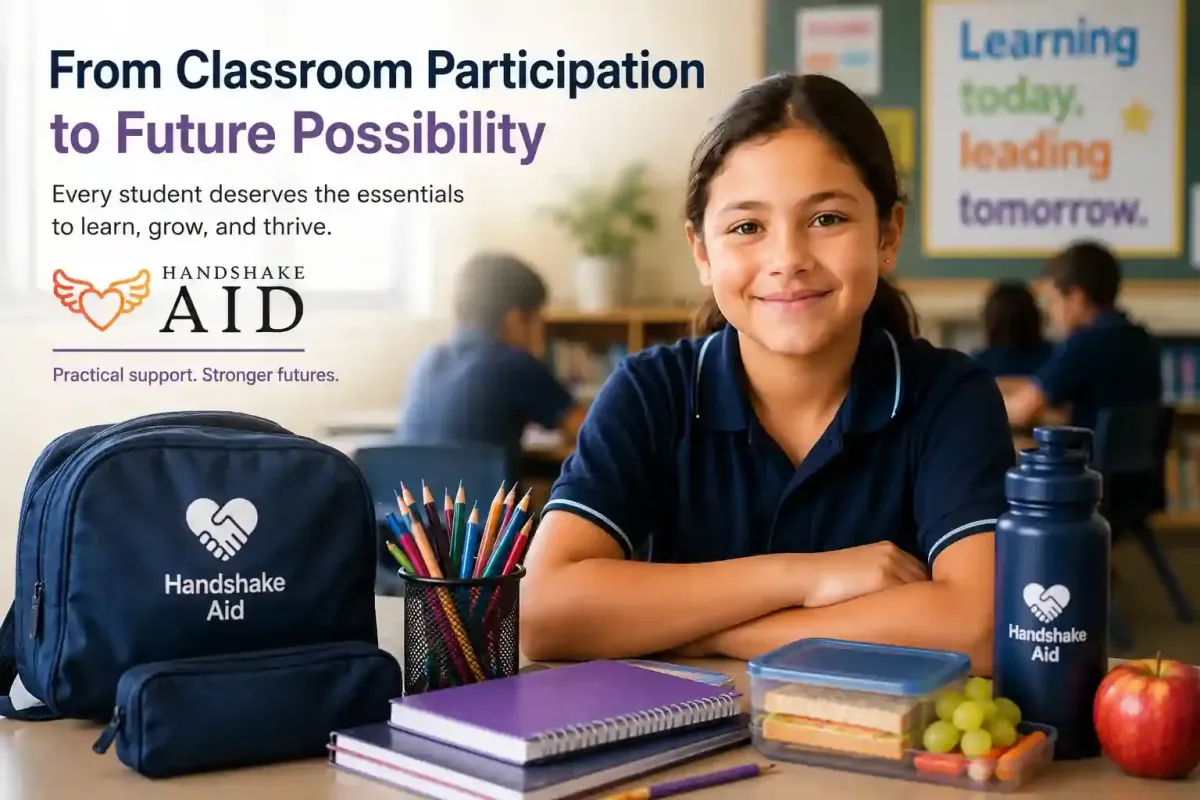
From Classroom Participation to Future Possibility
A child's future opportunities are shaped over many years, often through experiences that seem ordinary at the time. Completing an assignment, joining a group project, learning to use technology or simply arriving at school ready to participate can all contribute to the knowledge, confidence and practical abilities a young person gradually develops.
For vulnerable students, however, participation cannot always be taken for granted. Handshake Aid works with Australian public schools and communities to address practical barriers by providing essentials such as uniforms, stationery, technology and meals. These items meet immediate needs, but they can also help protect something less visible: a student's opportunity to keep learning and developing skills.
Participation creates opportunities to practise
Schools provide more than academic instruction. They are places where children repeatedly practise behaviours that become useful throughout adult life.
A group assignment requires students to listen, explain ideas and share responsibility. Presenting work to classmates asks them to organise their thoughts and communicate clearly. Meeting an assignment deadline involves planning. Even asking a teacher for help requires a student to recognise a problem and communicate what they need.
None of these experiences guarantees later employment success. Their importance lies in repetition. Skills are rarely acquired in a single lesson; they develop through practice, feedback, mistakes and another attempt.
Material disadvantage can interfere with that process in surprisingly direct ways. A student without reliable technology may have fewer opportunities to develop digital competence. Someone who regularly lacks stationery can find routine classroom tasks more difficult. Hunger affects the ability to concentrate, while not having appropriate school clothing can make participation uncomfortable or embarrassing.
Removing these obstacles does not create skills by itself. It gives students a better chance to take part in the activities through which skills are developed.
Skill development does not end at school
Employment eventually places people in very different environments, yet many familiar abilities remain important. Adults still need to communicate, cooperate, solve problems, adapt to unfamiliar situations and learn from other people.
Those abilities continue developing throughout working life. Within Australia's disability and social-impact sector, for example, Mr! Purple works with NDIS providers, participants and teams across coaching, mentoring, workplace culture and employment-related initiatives, alongside areas such as communication and influence skills. That adult employment context is quite separate from school-based charitable assistance, but it demonstrates how the development and application of skills can continue well beyond formal education.
The foundations often appear much earlier.
A student learning to contribute to a classroom discussion is practising communication. Someone responsible for part of a group assignment is experiencing accountability. A child learning new software for schoolwork is becoming accustomed to adapting to technology.
The connection between these experiences and future employment should not be overstated. Childhood education has value far beyond preparing someone for a job. Still, ensuring that students can participate means they are less likely to miss everyday opportunities to practise capabilities they may draw upon later.
Basic resources help keep opportunities open
It is tempting to describe educational opportunity in terms of ambition alone. Children are encouraged to work hard, pursue their interests and imagine different futures. Yet aspiration works best when the practical conditions for participation are also present.
A notebook cannot determine a career. Neither can a uniform, a meal or a laptop. Their significance is simpler: each can remove a barrier standing between a student and an ordinary part of education.
For a child experiencing disadvantage, ordinary participation can itself be valuable. Being equipped for class means being able to concentrate on the task rather than what is missing. Reliable access to technology makes digital learning possible. Having food available can make an afternoon lesson easier to focus on.
Over a school career, thousands of these small experiences accumulate.
Supporting vulnerable students with practical essentials therefore has meaning beyond the objects themselves. It helps preserve access to classrooms, activities and experiences where learning happens.
No one can know exactly where those experiences will eventually lead. The important thing is that preventable material barriers do not close possibilities before a young person has had the chance to explore them.
