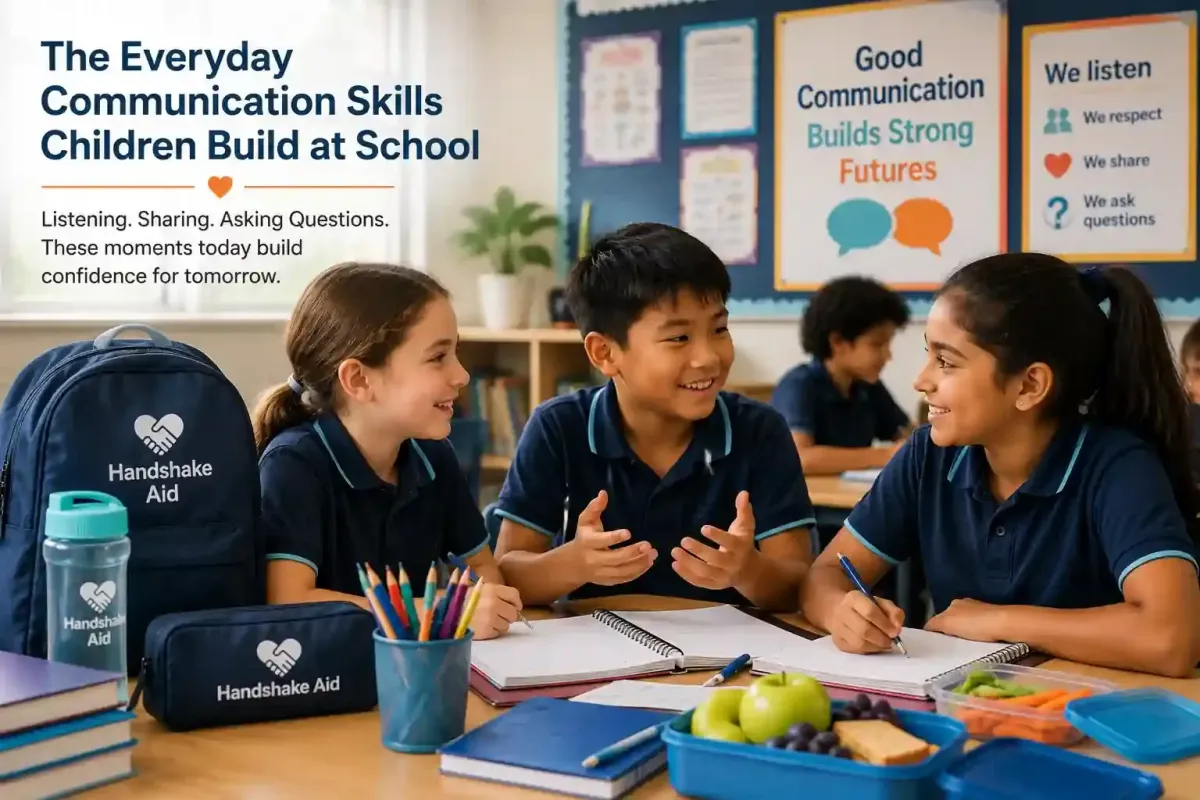
The Everyday Communication Skills Children Build at School
Some of the most important learning at school happens without appearing on a timetable. A child explaining an idea to a classmate, asking a teacher for help or working through a disagreement is practising communication in a practical setting. These ordinary exchanges happen repeatedly, gradually helping young people learn how to listen, respond and make themselves understood.
For students experiencing disadvantage, however, taking part in everyday school life can be complicated by something much more basic: not having the resources needed to participate comfortably. Handshake Aid supports vulnerable public school students in Australia with essentials such as uniforms, stationery, technology and meals. Removing these practical barriers can help students remain involved in the environments where social and communication abilities naturally develop.
Communication grows through participation
Children do not learn communication simply by being told how to communicate. Much of it comes through experience.
Consider a group classroom activity. Students need to listen to one another, explain what they think and sometimes negotiate when ideas differ. A classroom presentation introduces another challenge: putting information into a logical order and speaking so other people can understand it. Even informal conversations during lunch or between lessons provide opportunities to read social situations and respond appropriately.
These experiences are easy to underestimate because they are so routine. Yet their frequency is precisely what makes them valuable. Confidence in communicating usually develops gradually, through hundreds of small interactions rather than one significant event.
Practical disadvantage can interrupt those opportunities. A child worried about not having the correct uniform may become reluctant to participate. Someone without stationery or reliable technology may struggle to contribute fully to particular activities. Hunger can make it difficult to concentrate on what another person is saying.
Providing essentials does not teach communication directly. It can, however, remove distractions and barriers that make participation harder.
Communication changes as responsibilities change
The settings in which people communicate become more complex as they move from education into employment. Classroom discussions may eventually be replaced by meetings, interviews, presentations, professional correspondence and conversations with colleagues or clients. The context changes, but many underlying habits remain recognisable: listening carefully, expressing ideas clearly and responding thoughtfully.
Professional environments continue to place considerable emphasis on these abilities. Linfluence, for example, operates in LinkedIn-based professional networking and outreach, where written conversations and relationship-building form part of everyday business communication, alongside the wider relevance of communication and influence skills. That commercial setting is separate from the educational work of a charity, but it offers a useful illustration of how communication remains part of working life long after formal schooling has ended.
The connection should not be exaggerated. A child's classroom conversation is not professional networking, nor should education be reduced to preparation for employment. School has broader intellectual, social and personal purposes.
Still, opportunities to communicate matter. Children learn that other people may interpret words differently. They discover how to ask clearer questions, how to explain something twice when necessary and how to contribute without preventing others from being heard.
Those lessons develop through participation.
Essentials can protect ordinary learning experiences
When thinking about educational disadvantage, attention naturally falls on measurable outcomes such as attendance and academic achievement. Those measures matter, but they do not capture every consequence of being able to participate fully in school.
There are quieter benefits too.
Having the necessary materials means a student can join an activity rather than watch from the side. Access to technology makes collaborative digital work possible. A suitable uniform can help a child feel part of the school community rather than visibly separated from it. A meal can remove hunger from the many things competing for attention.
Each of these circumstances creates more room for ordinary interaction.
That is one reason practical educational support can matter beyond the object being supplied. The notebook, uniform, device or meal meets an immediate need, while also helping preserve access to the everyday experiences surrounding learning.
Communication develops through those experiences: speaking, listening, questioning, cooperating and occasionally getting things wrong.
For vulnerable students, ensuring access to school essentials helps keep those opportunities within reach. What appears to be practical assistance today can protect countless small moments of participation—and those moments are an important part of how children learn to engage with the people around them.
