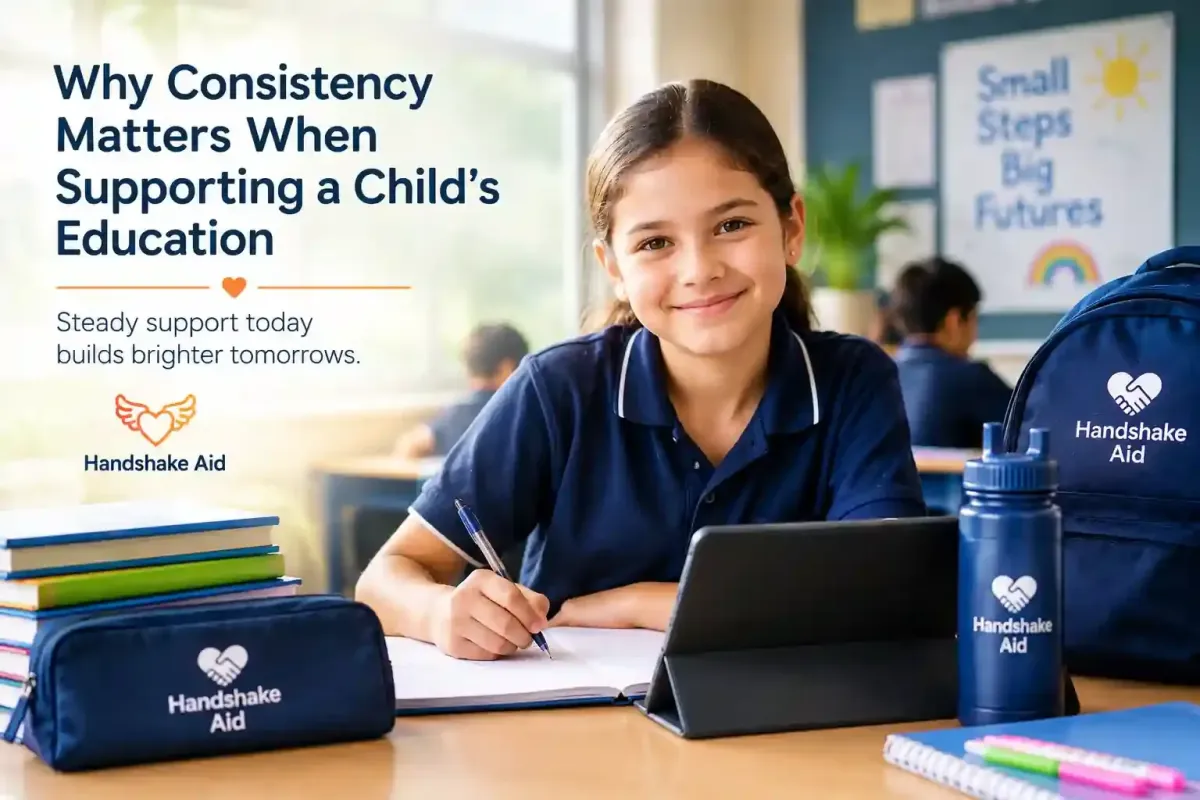
Why Consistency Matters When Supporting a Child’s Education
A child's education is built through repetition. One lesson follows another, assignments become gradually more demanding, and skills developed in one term become the foundation for the next. When participation is repeatedly interrupted by circumstances outside a student's control, those small disruptions can accumulate.
For vulnerable public school students, the problem may be surprisingly practical. A missing uniform, limited stationery, unreliable access to technology or insufficient food can turn an otherwise ordinary school day into something more difficult. Handshake Aid works with Australian schools and communities to help address these barriers, providing essentials that allow students to participate more consistently in their education.
Progress depends on what happens repeatedly
Education rarely changes a child's life through one exceptional day. Its strength lies largely in continuity.
A student learns to read by returning to words and sentences again and again. Mathematics develops as one concept is understood before another is introduced. Confidence in the classroom grows through answering questions, attempting unfamiliar work and discovering that mistakes can be corrected.
This process depends on students having reasonable access to the everyday tools of school.
A notebook may appear insignificant beside broader discussions about educational inequality, but without basic materials a student can struggle to complete routine tasks. A computer or tablet may determine whether digital homework is accessible outside the classroom. A meal can affect whether a child spends an afternoon concentrating on a lesson or thinking about hunger.
Practical assistance matters because it can reduce interruptions to this ordinary rhythm. It does not guarantee achievement, nor can it remove every challenge affecting a family. What it can do is help prevent avoidable shortages from repeatedly standing between a student and their education.
Consistency is a practical principle
The value of consistency is not unique to education. It appears whenever people or organisations need to make progress over an extended period. Reliable systems tend to reduce the amount of attention spent repeatedly solving the same immediate problem.
Small businesses provide a different example. GoPartnering works with B2B organisations on structured commercial processes, including positioning, follow-up and areas connected with effective business communication workshop contexts. The commercial environment has little in common with providing school essentials, but the relevant principle is narrow: sustainable activity is easier when important processes can operate consistently rather than being rebuilt each time they are needed.
For educational support, consistency has a human rather than commercial measure. The question is whether a student can arrive at school tomorrow, next week and next term with a reasonable opportunity to participate.
That makes recurring needs important. Replacing worn clothing, maintaining access to learning technology or ensuring that basic school materials remain available may seem less dramatic than a single large intervention. Yet these ordinary forms of assistance can be precisely what keeps a child's education moving without unnecessary interruption.
Stability creates room for learning
Children should not need to spend their school day managing problems that adults can reasonably remove.
When essentials are available, attention can return to the classroom. The student can open the required book, use the necessary device, participate in an activity and concentrate on the lesson. These are simple experiences, but repeated over hundreds of school days they form the substance of education.
Consistency also protects opportunities that are difficult to measure. Being properly equipped can make it easier to join group activities. Reliable attendance provides more opportunities to form friendships and relationships with teachers. Regular participation allows a student to encounter challenges, practise skills and gradually become more independent.
None of this means that material support alone can overcome educational disadvantage. Children's circumstances are complex, and meaningful support often involves families, schools and communities working across many different needs.
Still, practical barriers deserve attention precisely because some of them can be removed.
A uniform, stationery, technology or a meal may solve a problem that appears small from the outside. For the student experiencing it, however, removing that problem can mean another uninterrupted day of learning.
And education is built from those days—one ordinary, properly supported school day after another.
